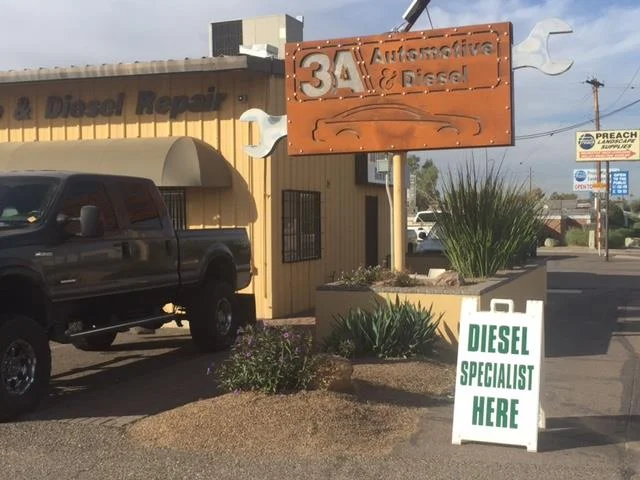
There’s a specific kind of panic that comes with watching your temperature gauge climb past the halfway mark while you’re boxed in on the 101 at rush hour. In Phoenix, where summer pavement temperatures regularly top 150°F and the air itself can hit 115°F, an overheating engine isn’t a rare fluke — it’s one of the most common roadside emergencies our team at 3A Automotive & Diesel Repair sees every summer.
If you see that needle creeping toward “H” or steam rising from under the hood, what you do in the next five minutes matters. Here’s exactly how to handle it safely, and what to do afterward to make sure it doesn’t happen again.
Step 1: Turn Off the A/C and Turn On the Heat
It sounds backwards, but running your heater at full blast when your engine is overheating helps pull excess heat away from the engine block and into the cabin. Turning off the air conditioning reduces the load on the engine immediately. Yes, it’s uncomfortable in a Phoenix summer — but it’s a lot more comfortable than being stranded.
Step 2: Get Off the Freeway Safely
Signal early and move toward the shoulder or the nearest exit. Don’t wait for the engine to completely fail before pulling over — continuing to drive an overheating engine for even another mile or two can turn an inexpensive coolant fix into a full engine rebuild. If you’re on a Phoenix freeway like the I-10, I-17, or Loop 101/202, look for the nearest exit ramp rather than stopping on the shoulder in live traffic whenever possible.
Step 3: Turn Off the Engine and Pop the Hood (Carefully)
Once you’re safely stopped, shut off the engine completely. Do not open the radiator cap or coolant reservoir right away — pressurized, superheated coolant can cause serious burns. Popping the hood (from outside the vehicle, standing to the side) helps heat escape faster and lets you visually check for obvious leaks, a snapped belt, or a hose that’s come loose.
Step 4: Wait It Out
Give the engine at least 15 to 30 minutes to cool down before doing anything else. In Phoenix heat, this can feel like forever, but rushing this step is how people get burned — literally. If you have water in the car, this is the time to stay hydrated and get to shade if you can do so safely near your vehicle.
Step 5: Check Coolant Level Only Once It’s Cool
Once the engine has fully cooled, you can carefully check the coolant reservoir level. If it’s visibly low and you have coolant or even plain water on hand, you may be able to add a small amount to get to the nearest repair shop — but this is a stopgap, not a fix. If the coolant is leaking out as fast as you add it, or you see coolant on the ground under the vehicle, don’t attempt to keep driving. Call for a tow.
Step 6: Call for Help
If you’re not confident the vehicle can be driven safely, or if you don’t have coolant on hand, it’s time to call a tow truck rather than risk further engine damage. 3A Automotive & Diesel Repair offers 24/7 discounted towing service for exactly this kind of situation — so whether you’re stuck on the 51 at 2pm or the I-10 at midnight, help is a phone call away.
Why Cars Overheat So Often in Phoenix
Extreme ambient heat pushes every cooling system to its limit, which means minor issues that would go unnoticed in a milder climate turn into full breakdowns here. The most common culprits we find when a car comes in after an overheating incident include:
Low or old coolant that’s lost its ability to transfer heat effectively, a failing thermostat stuck in the closed position, a radiator clogged with debris or corrosion, a leaking hose or gasket that lets coolant escape slowly over time, and a failing water pump that can no longer circulate coolant properly through the engine.
Any one of these issues is a straightforward, affordable fix when caught early during a routine inspection. Left unaddressed through a Phoenix summer, any of them can lead to a cracked cylinder head, a warped engine block, or a blown gasket — repairs that cost thousands more than a coolant flush ever would.
Preventing the Next Overheating Emergency
The best fix for a roadside breakdown is never needing one in the first place. Our team recommends a full cooling system inspection every spring, before the real heat sets in, covering coolant condition and levels, hose and belt integrity, radiator and fan function, and water pump performance. If your car is already showing signs — a temperature gauge that runs a little high, a sweet smell near the vents, or visible coolant spots in your driveway — don’t wait for a freeway breakdown to get it checked out.
Phoenix’s Trusted Auto Repair Shop Since 1975
3A Automotive & Diesel Repair has been family-owned and serving the Phoenix community since 1975, backed by ASE-certified technicians and a 3-year/36,000-mile warranty on repairs — up to three times longer than most dealerships offer. Whether you need an emergency tow after an overheating scare or want to get ahead of the problem with a cooling system check, our shop at 1539 W Hatcher Rd is ready to help.
Don’t wait for the next warning light. Call 3A Automotive & Diesel Repair at (602) 888-0588 to schedule a cooling system inspection, or reach out any time for our 24/7 towing service if you’re already stuck on the road. We also offer free pick-up and drop-off shuttle service so a repair never has to derail your whole day.